The short answer
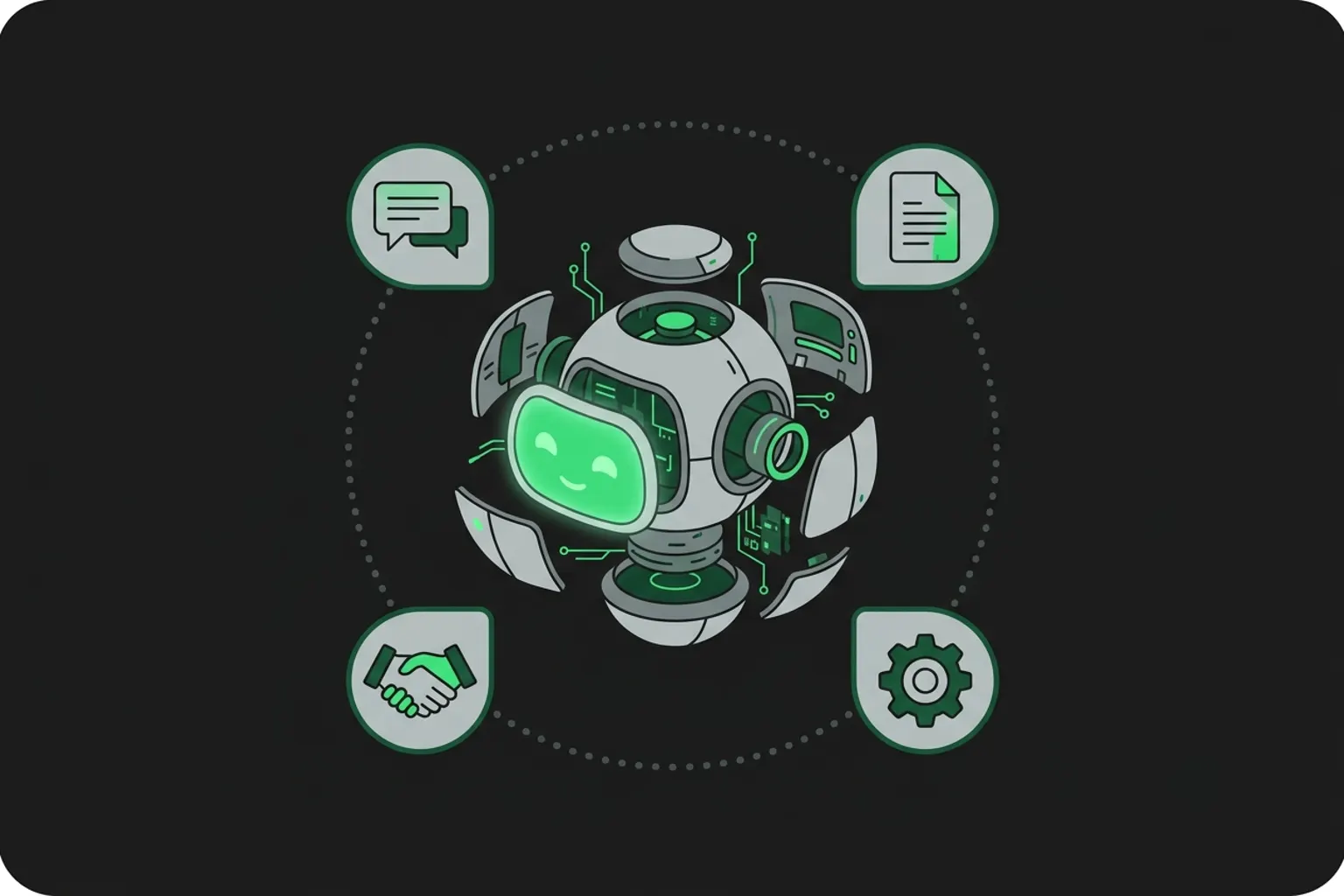
An AI agent is four things wired together: a language model that understands plain human messages, your business data (prices, stock, policies, opening hours), tools it is allowed to use (reply, check a calendar, create a payment link), and rules about what it may never do. It runs them in a loop. Read the message. Look up the answer in your data. Decide the next step. Act. Then check its own work, and hand the chat to a human the moment it is unsure. There is no thinking robot behind any of this, and the agent never goes off script, because you wrote the script. One agent we run quotes from a 42,000-product catalogue this way, and 64.1% of the chats it handles end in a sale. The rest of this page walks that loop step by step.
Last updated: July 24, 2026. Every measured number here comes from pages 41 Labs already publishes, read July 2026.
What is an AI agent, exactly?
Start with the thing most people already have in their head. A chatbot works from a script, or a stored set of answers. It matches your question to the closest entry and sends back what it finds, and when the question falls outside the script, you get the fallback line every customer hates. "Sorry, I did not understand that. Please call us during office hours."
An AI agent gets a goal instead of a script of answers. Reply to this customer, quote from these prices, book the job if they are ready. To do that, it reads the message with a language model, the same family of technology behind ChatGPT, then works through steps on its own: find the product, apply your rules, write the reply, take the action. We published a full comparison in our AI agent vs chatbot guide, and the one-line version has held up for years. A chatbot talks. An agent acts.
If you want it in normal business terms, an agent is a new salesperson with a perfect memory of your catalogue and zero authority to go off script. Every price and every product code, memorised on day one. They answer at 2am without complaint, never take leave, and reply in seconds. And they are on a tight leash. You never gave them discount authority, so they cannot knock 20% off to rescue a deal. They cannot approve a refund. When a customer asks something that appears nowhere in the catalogue, they walk over to your desk and ask, which in software terms means the chat gets handed to a human with the full history attached. Hold that picture. Everything below is that salesperson, described one step at a time.
What happens when a customer messages one?
Here is a real exchange, published on our 41 Closer page, from an agent we run for a Singapore industrial supplier. At 2:14am a customer writes: "Do you still have 200 units? Need them by Friday." By 2:15am the deal is quoted, confirmed, and paid. $2,400. Nobody woke up.
Between those two timestamps the agent ran its loop. Worth slowing the minute down, because none of it is magic.
First it reads. The model works out what the customer wants: a stock check, a price for 200 units, a Friday deadline. Plain language in, structured meaning out. This is the only part that feels like AI.
Next comes the lookup. The agent pulls the item from the catalogue data we loaded, checks stock, and finds the unit price. On that deployment the catalogue holds 42,000 products, so this step is a database query, and the model never gets the chance to guess a number.
The decide step is where your rules bite. Quantity confirmed, stock available, so the rules say quote the full amount and ask for the close. A customer pushing for a discount past the allowed line would get a different decision: hold the price, or hand the chat to a person.
Acting is the visible part. The agent writes the reply in the tone we trained, quotes $2,400, and when the customer says yes, it sends a payment link through the connected payment tool.
Last, the check. Payment confirmed, order logged, conversation closed. Had anything gone sideways, a wrong product match, an answer it could not verify, a customer getting heated, this same step routes the chat to a human. Then the loop starts again on the next message.
The five steps every message triggers. The loop-back is the point: an agent handles the whole conversation this way, message after message, and the hand-off to a human is a built-in step rather than a failure.
The same loop covers softer outcomes. A services business gets "any slots this Saturday?", the agent checks the calendar, offers 2pm, takes a $50 deposit, booked. A retail customer asks the price of a sofa and gets it with the delivery offer, plus a question: want me to hold one? Quote, qualify, book, or hand off. The steps stay fixed. Only the data behind them changes from one business to the next. Most agents we run live on WhatsApp, since that is where the customers already are, and we keep a plain guide to the WhatsApp side of this if that is your channel.
Source: measured figures for one live 41 Closer client, a Singapore industrial supplier, as published on 41labs.ai's 41 Closer page, July 2026. One client, and the three rows use different units, so bar lengths are indicative rather than comparable.
What do AI agents get wrong?
Now the part vendors skip. Agents fail, and they fail in patterns you can predict before launch.
Ambiguity is the big one. "How much for the usual?" means nothing to an agent unless order history is wired in. Two questions packed into one message can come back with one answer. A customer who types a product name slightly wrong can get matched to a neighbouring item, and on a 42,000-product catalogue that is a live risk, which is why confirmation questions exist.
The second failure mode is uglier. When data is missing, a language model does not go quiet. Its natural behaviour is to produce a fluent, confident, wrong answer. An agent with no limits will invent a price, promise a delivery date nobody can meet, or hand out a 40% discount, cheerfully.
Guardrails and hand-off exist for exactly this. On our agents the hard limits are written down: never invent a price, never promise a date the system cannot verify, hand off the moment confidence drops. On the live deployment above, our team still steps in for the tricky conversations, and the agent stays on script because we set the guardrails and watch it. The measured 64.1% close rate includes that human backstop. We would not publish the number without it.
There is an industry-sized version of this failure too. On our agency pages we cite the estimate that 80% of AI projects never make it into production, and the cause usually sits in the boring parts. Nobody cleaned the data, and the transcripts went unread after launch. Where AI belongs in customer conversations, and where it does harm, got its own article: AI customer service, honestly assessed.
What do you need to run one?
Three things. None of them is the AI.
Your data in clean shape. A price list in a spreadsheet the agent can read. Delivery rules and policies written down, out of the owner's head. The 20 questions customers actually ask, with the answers your best salesperson gives. We have watched builds stall for weeks because the prices existed nowhere outside one person's memory. The model itself is rented from Anthropic, OpenAI, or Google for cents per conversation, and it is the cheapest part of the whole build. The data work is yours. It is also where projects die.
A channel. Web chat is the easy one. WhatsApp is where the money is for most businesses we serve, and it brings extra plumbing: the WhatsApp Business API, Meta's approval process, per-conversation fees on top of whatever tool you use.
Someone watching the numbers. A production agent needs a person who reads transcripts weekly, catches wrong answers, and tunes the instructions. Every failed chatbot we have been asked to rescue skipped this part. Every one.
For the full build path, from picking the agent's one job through going live, we wrote a step-by-step guide on how to create an AI agent, DIY costs included. On cost, simple FAQ tools run US$29 to US$79 a month. Our managed agent goes live in 48 hours from S$690 a month, and fully custom builds take 3 to 8 weeks at S$7,000 to S$25,000.
Agent, chatbot, or automation: which do you need?
Match the tool to the money inside the conversation.
If 70% of your enquiries are the same 15 questions, opening hours, price list, directions, a chatbot at S$50 to S$500 a month handles them well, and buying an agent for that job is overspending. A decent FAQ chatbot deflects 60 to 80% of support volume on its own.
If there is no conversation at all, you want plain automation. Form submission lands in the CRM, the invoice goes out, a reminder fires on day 7. Zapier-class tools do this without any AI in the loop, for less.
An agent earns its cost when each conversation carries real money and needs judgment mid-flight. Quoting from a live catalogue. Qualifying a lead before your closer spends an hour on it. Or the $50 deposit that turns a maybe into a confirmed Saturday booking. If slow replies at night and on weekends are costing you sales, that is agent territory, and the arithmetic takes two minutes: count the enquiries you miss each month, multiply by what a customer is worth.
Still on the fence? There is a shortcut nobody writes about because it feels too obvious. Go talk to one.
Frequently asked questions
How does an AI agent make decisions?
It applies the rules it was given, through a language model that has read your business data. When a message arrives, the agent matches it against your catalogue and policies, then picks its next move from a short list of allowed actions: answer, quote, ask a qualifying question, book, or hand off to a human. It does not improvise outside that list. On the agents 41 Labs runs, the hard limits are written down, like never invent a price and never promise a delivery date the system cannot verify. The quality of the decisions tracks the quality of the rules and the data, which is why the setup work matters far beyond the choice of AI model.
Do AI agents learn on their own?
No. A production agent does not quietly retrain itself on your conversations. It behaves the same way today as it did yesterday, until someone deliberately updates its data or its instructions. That is by design. An agent that changed its own behaviour week to week could never be trusted with prices, bookings, and payments. In practice a person reads the transcripts, spots wrong or awkward answers, and updates the prompt or the data. On the agents 41 Labs runs, that tuning happens weekly. So the agent does improve over time, but every improvement is a change a human chose to make, and drift stays under control.
How accurate are AI agents?
As accurate as the data behind them. An agent quoting from a clean, current price list gets prices right all day. The same agent pointed at a stale spreadsheet is confidently wrong, which does more damage than no answer at all. Accuracy also drops on ambiguous messages, so a well-built agent hands those to a human instead of guessing. This is why 41 Labs builds a working prototype on a client's real data before any payment: the prototype surfaces the messy data on day one, while it is still cheap to fix. On our best live deployment, 64.1% of handled chats end in a sale, with humans covering the tricky ones.
What is the difference between an AI agent and ChatGPT?
ChatGPT is a general language model you chat with. It has no access to your stock, your prices, or your calendar, and it cannot take actions in your systems. An AI agent wraps that same kind of model with your business data, tools it may use, and rules it must follow. Ask ChatGPT what a sofa costs and you get a generic essay. Put the same question to an agent connected to a furniture catalogue and you get the price, a delivery option, and an offer to hold one. The engine is similar. The wiring around it, your data, your tools, your rules, is the part you are actually buying.
See one work, right now
Everything above is description. Five minutes with a live agent teaches you the rest. Message +65 8012 4848 on WhatsApp and ask it hard questions: a price, a delivery timeline, something ambiguous, something that should force a hand-off. Watch where it answers, where it qualifies you, and the exact moment it decides to pass you to a person. The system that replies is a production agent we built and run, so you are watching this entire article happen live, on your own phone.